RStudio installation on Windows 10/11
 Image credit: Panos Sakalakis on Unsplash
Table of Contents
Motivation
Whether working, or studying everybody uses various sorts and types of software on their computer. Students taking Statistical Courses, as taught by the Mathematical and Statistical Methods group at Wageningen University & Research, will most likely use R.
Some of these courses (e.g., MAT20306 Advanced Statistics, MAT27803 R for Statistics, and MAT32806 Statistics for Data Scientists) mainly use RStudio. Also other courses (e.g., HNH45306, and BIF21306) taught at Wageningen University & Research use R through RStudio as well. Therefore, students will need to be able to install RStudio.
Two ways to install R are offered here:
- WUR AppStore. This is the RECOMMENDED way!
- Manual installation for those who, for whatever reason, do not want to use the WUR AppStore.
Installation
1. WUR AppStore
The WUR AppStore is the place where you will be able to download, link to, or virtually access the software you need for your study program and courses. Not only during, but also for self-study after, the computer practical’s and courses.
Prior requirement for the installation of RStudio via the WUR AppStore:
The WUR AppStore currently contains RStudio version 2025.05.1 Build 513 named “RStudio 2025.05.1.513”.
2. Manual Installation
Download
At the time this post was written, the latest stable release of RStudio was version 1.2.5033. The post has been updated to the current stable release version 2025.09.2 Build 418 (named “Cucumberleaf Sunflower”).
Download RStudio using the following link: RStudio 2025.09.2 Build 418 (ca. 296.74 MB)
For newer versions of RStudio the steps described after the download are the same, but starting with a newer version of the RStudio executable file.
RStudio Installation
Prior requirement for the installation of RStudio:
To be able to install RStudio you will need to have R installed first. If you haven’t done so already, please first install R on your Windows 10/11 computer (use the link above to go to that specific post).
To install RStudio on Windows 10/11 perform the following steps:
- Open the downloaded file RStudio-2025.09.2-418.exe. This file will most likely reside in the Downloads folder of your user account.
- Allow to install the software on your computer.
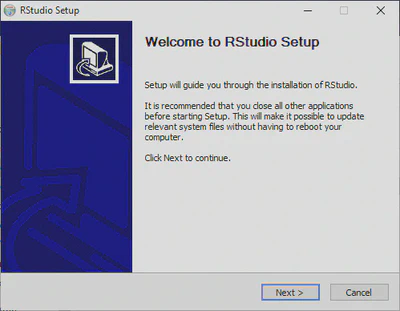
- After the installler has started, a Welcome window will appear as displayed below in Figure 1. Click the ‘Next’ button to proceed.
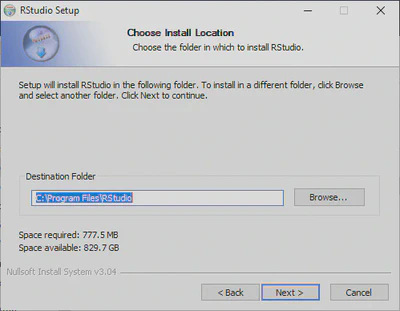
- Now the RStudio Setup will allow you to select the installation location by selecting a destination folder, as shown in Figure 2 below. Leave the default specified folder or, if you know what you are doing, select an alternative installation destination folder, then click the ‘Next’ button to continue.
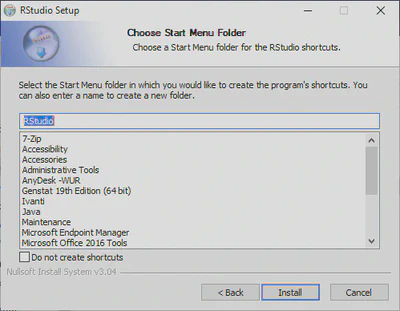
- Next the RStudio Setup allows choosing a Start Menu folder, as displayed below in Figure 3, where the RStudio shortcut to start the program will be put. Click on ‘Install’ to start the installation of RStudio.
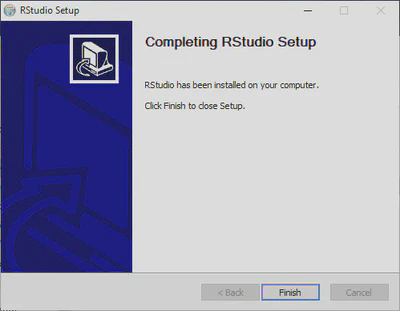
- Once the installation of RStudio has finished, the window will look like the one shown below in Figure 4. Click the ‘Finish’ button to close the setup.
Resetting RStudio desktop’s state
RStudio Desktop stores its internal state in a hidden directory. If this directory does not exist, RStudio will create it on start up. This directory includes information about open documents, log files, and other state information. Removing (or renaming) this directory will reset RStudio’s state.
It is recommended to rename this directory to create a backup version instead of completely deleting it. This allows saving your settings, in case needed to revert back to them. Additionally, if experiencing a crash or RStudio failed to start, this directory may contain vital information for determining the source of the error.
Starting with RStudio 1.3, user preferences are stored in a separate folder from internal state. This allows for performing a state reset without losing settings, and also allows for preferences to be sync’ed between machines (in e.g., AppData\Roaming on Windows) while internal state is machine specific.
Some versions of RStudio Desktop store additional preferences (such as the size and location of the window and the rendering mode) in a separate location. To fully reset state, this must also be deleted or renamed, as described below in “Resetting Other Preferences”.
When using RStudio Projects, it is also recommended to reset the project-specific state if experiencing issues - this can done by navigating to the Project’s folder in the file browser, and renaming the .Rproj.user directory there.
Accessing the RStudio-Desktop Directory (Internal State)
Open a File Explorer window into the RStudio-Desktop directory by typing the following command into Start -> Run:
%localappdata%\RStudio
For older versions of RStudio (v1.3 and older), the state is stored here:
%localappdata%\RStudio-Desktop
Rename the directory Rstudio or RStudio-Desktop, e.g. to old_Rstudio. The environment variable %localappdata generally resolves into the folder C:\Users\<username>\AppData\Local, where <username> reflects the username of the current user.
Resetting other preferences
Open an Explorer window into the RStudio preferences directory by typing the following command into Start -> Run:
%appdata%\RStudio
Rename the directoryRStudio, e.g. to old_Rstudio. The environment variable %appdata generally resolves into the folder C:\Users\<username>\AppData\Roaming, where <username> reflects the username of the current user.

Maikel Verouden, Ph.D.
Researcher | Lecturer | IT & Organization contact person
My research interests include Statistics, Teaching and programmable matter (statistical software).